



 Cargando...
Today’s Cuba demands a union that resembles the current economic, labor, and social framework. This has been said many times, but it must now be turned into reality, because this organization is running out of time—the time for drastic change.
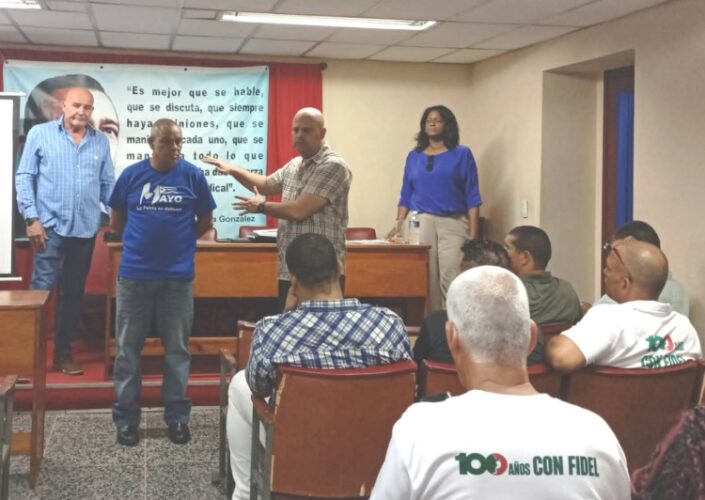
With clear and direct words, the reflection was made by the Secretary General of the Workers’ Central Union of Cuba (CTC), Osnay Miguel Colina Rodríguez, during an exchange with leaders in the western province of Matanzas.
How to strengthen the work of the CTC and its unions?
“What concerns us, we have already debated,” he reiterated. “The 22nd Congress was an expression of that. We must act, transform,” and that is the purpose of seminars like the one held in Matanzas.
He explained that the congress set out the key issues to which the union movement must devote itself in order to strengthen its structures: the assembly of members and workers, representation, conflict mediation, collective bargaining, protection of labor and social rights, and thus, through participation and popular control, contribute to the progress of productive activities.
Colina called for moving from empty words to real action, without rhetoric, to mobilize and honor the union’s role in line with the context of the social and economic transformations contained in the 176 measures.
“Decisions must be built from the grassroots: the preliminary figures of the economic plan and budget, systems and control environments, administrative accountability… We cannot see things in isolation, separately, but as part of a system,” he emphasized.
He acknowledged that “workers are in the collectives, situations happen there, in that space… We must push, demand, act, transform within the collective,” he pointed out. “Every month we have a number of issues to address at the grassroots level, impacting workers, and that means not resting.”
He referred to the urgency of removing the “fences” around workplaces, in order to reach that “closest portion of community, of neighborhood, and be able to attend to it integrally in the place where the labor collective resides.”
In those same spaces, he insisted, there are colleagues in telework, in remote modalities, interrupted, as happens here in Matanzas, some of whom have already lost their salary guarantees. And in those neighborhoods, he said, there are electricians, carpenters, plumbers.
“If all of them could be organized by the CTC and the unions into production and service brigades, for example, how many problems could be addressed, resolved, and thus strengthen the organization,” asked the CTC’s Secretary General. “Our participation in Mi barrio por la Patria must be seen with integrity,” he reiterated.
He stressed the importance of finally erasing the gap between saying and doing. The top leader of the Cuban union movement called to “get more involved in food production, energy transition, defense preparedness, and relations with international unions.”
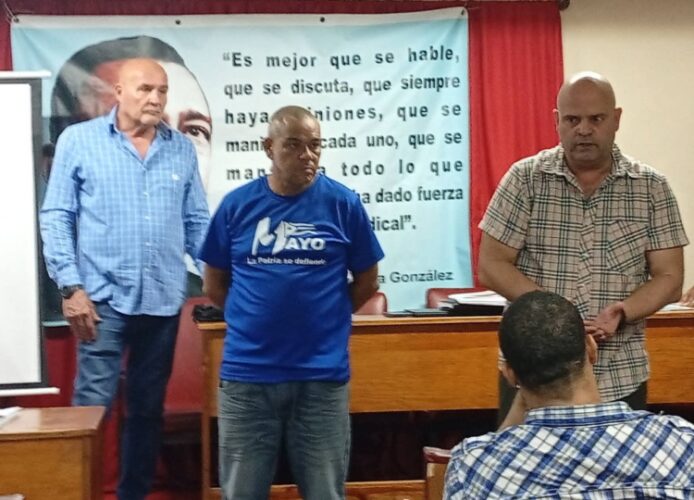
On his working visit to Matanzas, Colina was accompanied by the CTC’s Second Secretary, Ekaterina Gowen Dickinson, and Secretariat member Santiago Badía, head of the International Relations sphere.
