


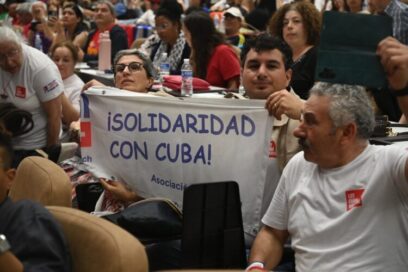

 Cargando...
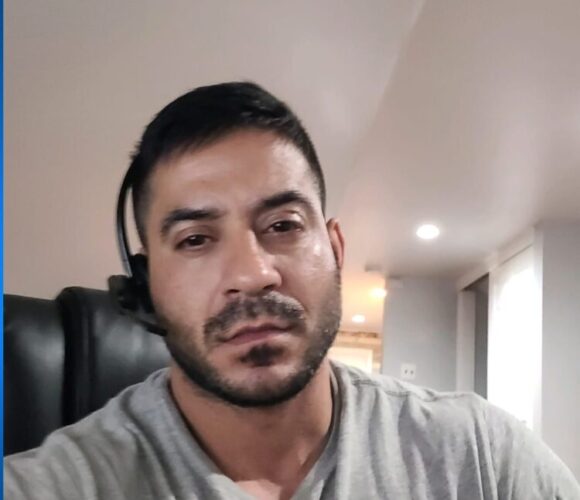
Víctor Coronado was born in Perth Amboy, New Jersey, into a family of Dominican immigrants. Today he is committed to the struggle for social justice, solidarity with Cuba, and political transformation in the United States. On March 25, 2026, the day he turned 46, Coronado returned home from an experience that will likely mark his life forever: he participated in the Nuestra América solidarity convoy and lived firsthand the reality of the Caribbean nation, including blackouts and the most recent disconnection of the National Electro-Energy System.
How did your relationship with Cuba begin?
It began in my early twenties, when I started to take an interest in the Cuban Revolution. It was a gradual process of learning and awareness that led me to adopt a position of solidarity with the Cuban people.
What or who led you down that path?
It was an individual experience. Over the years I contributed time and resources whenever I could. Recently, I joined the “Hands Off Cuba” Committee, which engages in more direct and systematic activism. Nevertheless, nothing I had done before compares to participating in the Nuestra América convoy. This has been the deepest and most intense experience of my life as an activist.
The convoy was a gesture of solidarity that also profoundly impacted Cubans. Many of them, upon receiving the aid, were moved to tears. It is a reminder that Cuba is not alone, and the world is more aware than ever of the injustice it has suffered. We must not allow them to continue being forgotten.
Had you visited the country before?
No, this was my first time. I have just discovered that I should have done it earlier. It is an experience that has enriched me deeply.
How would you describe the Cuba you found in March 2026?
Cuba is a fascinating country. Despite the difficulties imposed by the blockade and the current crisis, the Cuban people maintain an admirable social organization. I saw a civilized, peaceful society, respectful of the rule of law. Cubans have an impressive collective consciousness. Their society is far ahead of many other countries in the region, including the Dominican Republic, where my family comes from.
What did you do during this visit?
We had the opportunity to listen to President Miguel Díaz-Canel at the Convention Palace; to learn more about the Cuban health system and the fundamental role of women in the Revolution. I also toured Old Havana and was impressed by the city’s rich history and by the social programs sustained by the Office of the Historian in the community. It was an experience that nourished my soul.
Cubans are exceptional people, with a human depth that is hard to express. They are proud, dignified, educated, and courageous. There is much to learn from them, especially about how they uphold their sovereignty in the face of external pressures. I would like the Dominican people and the rest of Latin America to be inspired by Cuba’s example.
What happened upon your return to Miami?
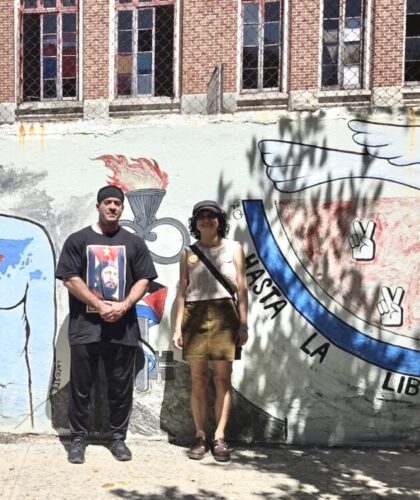
The Border Patrol at Miami Airport detained several of us who participated in the convoy—exactly 18. We were interrogated and our phones were confiscated, which is why I have no photos of my stay in Havana. Clearly, they were gathering information, something I consider a violation of our constitutional rights. What will happen to me from now on I do not know, but it is clear that surveillance is intensifying.
What more can solidarity movements do for Cuba?
I believe we must build a popular movement that drives real change in U.S. policy. We cannot wait for politicians to act of their own accord. It is necessary to take power away from the ruling class and put it in the hands of a progressive and revolutionary people. Our task is to make the revolution in our own country.
What do you think of the internal situation in the United States, especially what Latinos face?
The crisis in the United States is becoming deeper. Inequality is growing, and the working class—especially Latinos—bears the greatest burden of capitalism. Yet the U.S. system remains focused on waging war and intimidation, an attitude that is increasingly unsustainable. It is time for ordinary people to organize and work to wear down the structure of political power and thus reform it. The situation will not improve unless we act together.
Thanks to the Nuestra América convoy and the days spent in Havana, Víctor Coronado now has a clearer vision of Cuba and has also reinforced his conviction that the struggle for justice, sovereignty, and peace is an urgent task.
