



 Cargando...
Salvador Valdés Mesa, Vice President of the Republic of Cuba, began his tour of Consolación del Sur at the farm of fruit producer Alexander Rodríguez Lima.
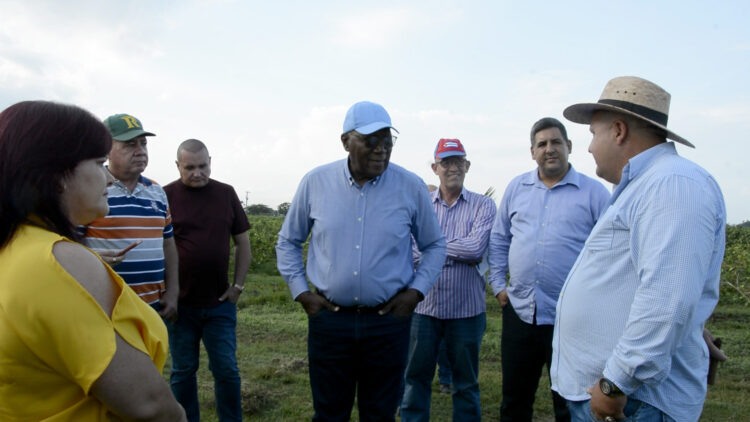
The 36 hectares of land he farms under usufruct are located in the Herradura municipality. The land was formerly part of the Troncoso Citrus Company’s agricultural assets and was transferred to the Tabacuba Business Group.
Rodríguez Lima explained that he is an agricultural engineer who graduated from the University of Montañas in La Palma, his hometown. He began promoting fruit plantations a little over a decade ago, starting with nine hectares of guava trees.
He said that people called him crazy, but his grandfather told him that it was best to plant a lot. It was this lesson from his farming ancestors that encouraged him to take risks.
This farmer’s guidelines broadly include staggered planting as a strategy to mitigate the impact of hurricanes and other manifestations of climate change; production of seedlings using the cutting method to shorten the production cycle; secure hiring; and constant work.
Although it employs 22 people from the area, it has not achieved the desired stability in its workforce. The partnership with Tabacuba provided access to a technology package for guava plantations, the main crop at Vista Alegre, which increased harvest volumes.
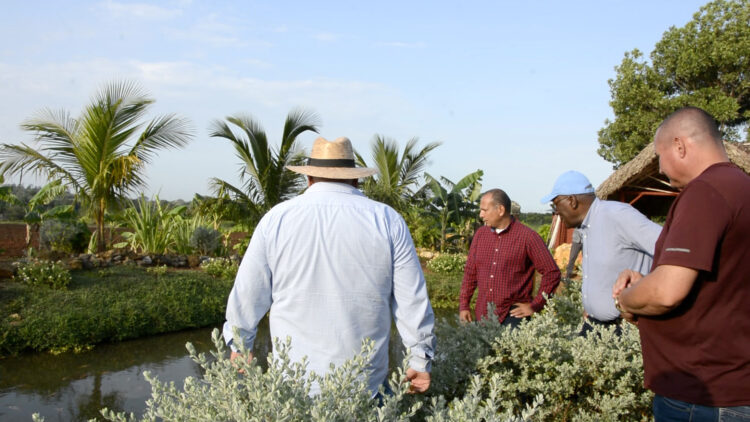
The main destination is the industry sector, specifically Troncoso, although it also makes deliveries for social consumption.
Other issues discussed with the vice president included the need to migrate to photovoltaic irrigation systems, the promotion of aquaculture, and plans to plant two hectares of sun-cured tobacco for the next season.
Valdés Mesa presided over the national Tobacco Workers’ Day ceremony at the Paulina Pedroso factory in Consolación del Sur, the municipal capital.
During the commemoration, men and women who had worked in the sector for 20 or 25 years, respectively, were awarded the Carlos Baliño Order. William Licourt, secretary general of the National Union of Agricultural, Forestry, and Tobacco Workers, presented the awards.
Young Ernesto Suárez Plasencia spoke on behalf of the cigar rollers and confirmed that his generation is honored to continue a trade linked to both local and national history. During his speech, Suárez Plasencia evoked the memory of union leader Lázaro Peña.
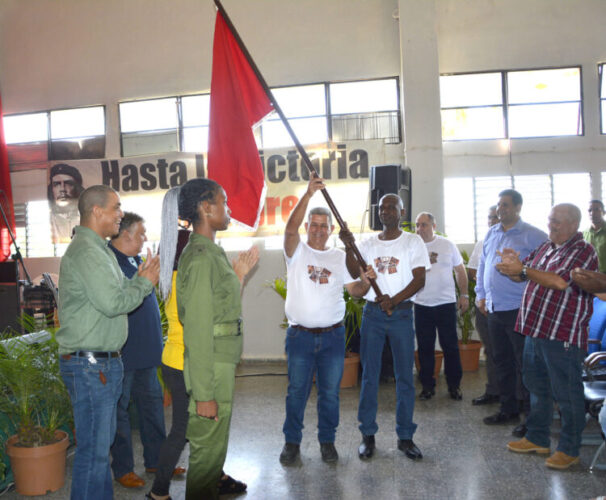
During the ceremony, two 80th anniversary stamps from the Cuban Workers’ Union were presented, along with a flag certifying the Agricultural Transport Company’s workers as a National Vanguard Collective. The Rolled Tobacco Company received an award for hosting the commemoration.
Licourt addressed the challenges currently facing the sector, as well as the certainty that tobacco growers will continue to seek greater efficiency and higher economic indicators.
The vice president emphasized the significance of holding the anniversary celebration in Pinar del Río, a province responsible for 70 percent of the country’s tobacco production. He noted that nothing and no one can replicate the quality of the region’s tobacco leaves. This underscores the importance of recognizing the efforts of tobacco growers.
On January 28, Valdés Mesa visited the mechanized poultry farm, where he learned about the cooperative production between this entity and the Tabacuba Business Group. This collaboration benefits both parties, reduces imports, utilizes existing technological capabilities, and establishes guidelines for replication in other provinces based on closed financing schemes.
Marino Murillo Jorge, president of the Tabacuba Business Group, explained that some of the funds allocated for purchasing food for workers are used to buy feed and other supplies. This allows the company to meet some of its workers’ nutritional needs and contribute to social consumption.
Valdés Mesa pointed out that, although the U.S. economic, commercial, and financial blockade of Cuba is the biggest obstacle, alternatives must be sought to gradually revitalize various sectors. He added that the poultry industry has been one of the sectors most affected by the current situation.
Acerca del autor

Licenciada en Periodismo (1995 Universidad de Oriente). Trabajó como periodista en Tele Cristal (Holguín) hasta marzo del 2003, directora y guionista de televisión.
Periodista del semanario Guerrillero (Pinar del Río) desde mayo del 2003 hasta la actualidad, corresponsal del semanario Trabajadores en esa provincia desde septiembre del 2020.
Creadora audiovisual y cinematográfica independiente.
