



 Cargando...
The recently approved economic and social transformations pose a challenge that, for the trade union movement, cannot be reduced to simply learning about these measures, explaining them at a meeting, or subsequently mobilizing workforces to implement them. Rather, they raise a deeper question: What role does the trade union play in this process?
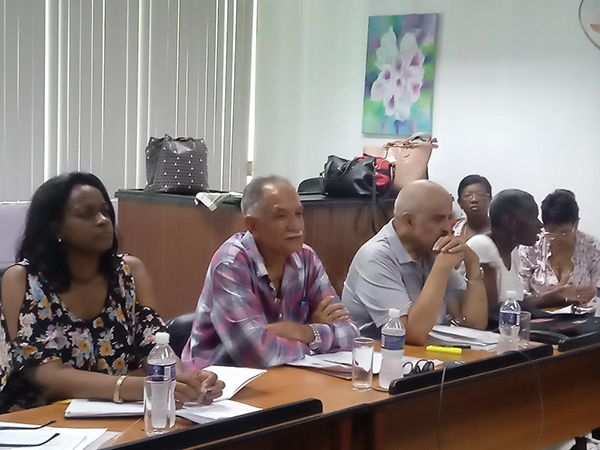
The question is pertinent because the 176 transformations encompass 23 areas and extend to such sensitive matters as the management model for economic actors, business autonomy, property relations, planning, wage and pricing policies, subsidies, the financial system, agricultural recovery, municipal autonomy, and control and inspection mechanisms.
Many of these decisions, therefore, will ultimately take shape precisely where the trade union has its reason for being: in the workplace. It is no coincidence that, in closing the 22nd Congress of the Workers’ Central Union of Cuba (CTC), First Secretary of the Central Committee of the Communist Party of Cuba and President of the Republic Miguel Díaz-Canel Bermúdez placed workers at the center of this challenge.
In this regard, he stated that “without the conscious mobilization of workers, nothing will be possible,” neither the major leap in production demanded by the national economy nor the quality of control and oversight processes.
Collective Participation, the Driving Force of Transformation
The Cuban trade union movement faces two inseparable responsibilities. One is to mobilize productive reserves and encourage efficiency, innovation, savings, and the effective use of resources in order to contribute to the leap forward the economy needs. The other is to effectively represent workers in the decisions accompanying that process.
One should not exist without the other. The country needs to produce more and generate greater material and financial resources to sustain its social objectives. But that outcome does not depend solely on calls for greater effort. It requires discussion at every workplace about what is hindering production, where untapped potential lies, how much can be resolved by the company itself, and which obstacles fall outside its authority.
Thus, conscious participation cannot be built simply by telling workers what they have to do. It must also incorporate their answers to essential questions: What can we do? How can we do it better? And what needs to change in order to achieve it?
This approach has roots in Commander in Chief Fidel Castro Ruz’s thinking on the labor movement. Studies of his relationship with workers highlight unity as a constant theme and place the working class in a leading role within the revolutionary process. They also recall the importance he attached to consulting workers when complex decisions had to be made.
This takes on particular significance now that new economic powers are shifting a considerable share of decision-making to companies and local territories.
Greater Authority, Greater Participation
One of the most significant changes grants greater autonomy to the state enterprise system. Among other powers, decisions related to prices, business organization, and the use of profits are being decentralized. Of particular significance to the trade union movement is the approval of the wage scale: wages are to be negotiated with workers and with trade union participation, in accordance with each company’s economic and financial capacity. Here, trade union involvement ceases to be an abstract concept.
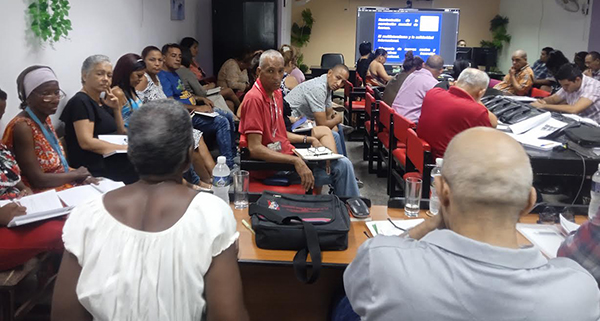
Decentralization, therefore, cannot simply mean greater managerial authority. It must also entail a greater capacity for the workforce to understand, discuss, and oversee decisions that directly affect their work and income.
The Leap Forward Cannot Be Just a Slogan
Cuba needs a leap forward in production. The transformations themselves seek to restore economic capacities, expand business autonomy, stimulate agriculture, and modify management, planning, and financing mechanisms. Calls for increased production will have greater credibility when they are accompanied by discussion about how to eliminate the obstacles that hinder production.
Difficult external circumstances do not eliminate domestic responsibilities. During the presentation of the transformations to the National Assembly, domestic errors and shortcomings were also acknowledged, alongside the effects caused by coercive measures imposed by the United States.
The trade union movement can play a decisive role here: helping to distinguish between factors that a workforce cannot change and those that can be addressed through better organization, stronger oversight, participation, innovation, or greater accountability.
Oversight Is Also a Form of Participation
President Miguel Díaz-Canel Bermúdez’s remarks place another issue alongside the leap forward in production that should not be overlooked: control and oversight. Achieving certain economic results is not enough. How those results are achieved, how resources are used, and how much workers know about these matters are equally important.
Indeed, the transformations include a specific area aimed at improving control and inspection mechanisms. But control should not be understood exclusively as an inspection imposed from outside. Workers’ knowledge of plans, resources, and results can also become a safeguard against indiscipline, inefficiency, and misconduct.
The challenge is not to confuse support with complacency. Defending the transformations also means pointing out, in a timely manner, what is not working.
