



 Cargando...
The initial meeting of the new Hands Off Cuba Committee in Atlanta was diverse in composition and lively in the enthusiasm shown by more than 35 people who supported the initiative of the Delegation of Labor and Youth Activists, which traveled to Cuba to attend the May Day celebration organized by the Workers’ Central Union of Cuba (CTC in Spanish).
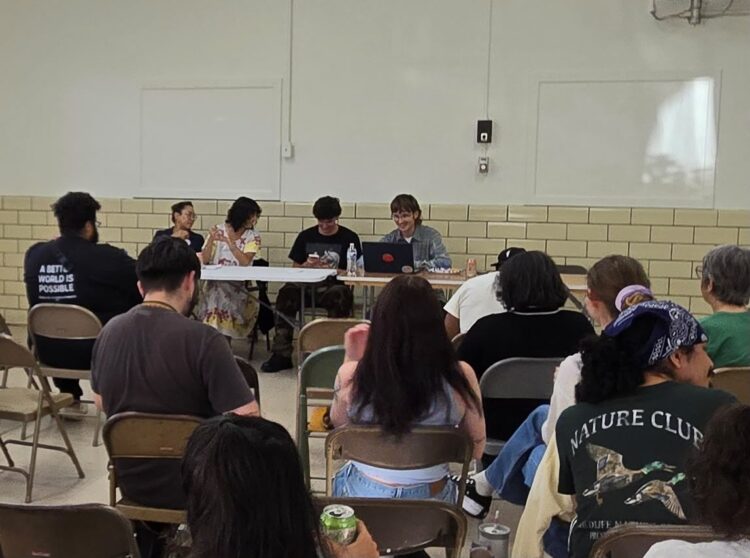
According to a report sent to this journalist by unionist Mark Friedman, co-founder of the Hands Off Cuba Committee, the event was attended by Teamsters, Amazon workers, members of the Logistics Workers League, teachers, and members of the Democratic Socialists of America (DSA). Also present were representatives of the National Lawyers Guild (NLG), the National Conference of Black Lawyers, the African People’s Socialist Party, Veterans for Peace, and antiwar and pro-Palestinian community activists.
One of the speakers, activist Hunter Richau, told attendees that the recent visit to Cuba made them reflect on the current situation of the island and what should be done to counteract the sanctions imposed by Donald Trump’s government, especially the oil blockade: “We saw Cuba before a total oil blockade and then experienced the blackouts firsthand,” Richau said.
Cuban trade unionists told us about their struggles and how they were forged during the revolution that took power in 1959; how work is organized and represented up to the highest levels of government, as well as the central leadership role of the Communist Party of Cuba. We learned a lot during the ‘Internship’ — an exchange and training program for unionists — and from meeting with the CTC’s secretary general, Osnay Miguel Colina Rodríguez.
Another speaker at the Atlanta event was Luke Badger, a Teamsters activist and union leader at an Amazon warehouse in Atlanta, who shared his experience of seeing firsthand how unions and Committees for the Defense of the Revolution (CDRs) operate, as well as the democratic model of People’s Power Assemblies at municipal, provincial, and national levels: “We also learned about the restructuring of the economy to meet workers’ needs,” he said.
“Our delegation participated in voluntary work days — an experience initiated by Che Guevara in the early years of the revolution to foster political consciousness and development. There we confirmed that the Cuban people understand sovereignty and self-determination as two elements intrinsically linked to their existence,” Badger noted.
Brenda López, co-founder with Friedman of the Hands Off Cuba Committee in Los Angeles (Lahoc), which has expanded to several U.S. cities, argued that Cuba is “a living experience, an example of what we fight for: affordable housing, as well as free health care and education. However, due to the strangulation imposed on the nation through the blockade, sanctions, and its inclusion on the list of countries suspected of supporting terrorism, a large number of well-trained Cuban youth and professionals are emigrating.”
“The United States attacks Cuba because it represents an example of what is possible. Cuba prioritizes its people and those of the rest of the world. It does so despite the difficulties. Its resilience and the pride they feel in their revolution are an example for all workers,” López concluded.
Anna Capati, a member of the Hands Off Cuba Committee in San Diego and of the National Lawyers Guild, commented that after her recent visit to the Caribbean nation, “by observing the successful health programs and literacy initiatives, one can appreciate what Cuba has contributed to the world through its example. I encourage you to organize your own delegations to Cuba to see the country firsthand,” she said.
Those present at the Atlanta meeting also discussed actions organizations and individuals could take to raise awareness on the issue, including public meetings, film screenings, and medical aid collections, such as the new campaign by Global Health Partners to obtain supplies for maternal health.
The attendees decided to focus the Committee’s action program on supporting Cuba’s sovereignty and gathering support within Atlanta’s labor movement, using as a starting point some of the union resolutions already approved, such as that of California’s AFL-CIO.
Participants purchased printed materials and books worth nearly two hundred dollars, funds that will be used for humanitarian support to Cuba.
Against Raids and in Favor of Cuba
At the same time, two teams of Lahoc activists took part in major protests against ICE deportations and raids in Los Angeles on July 25.
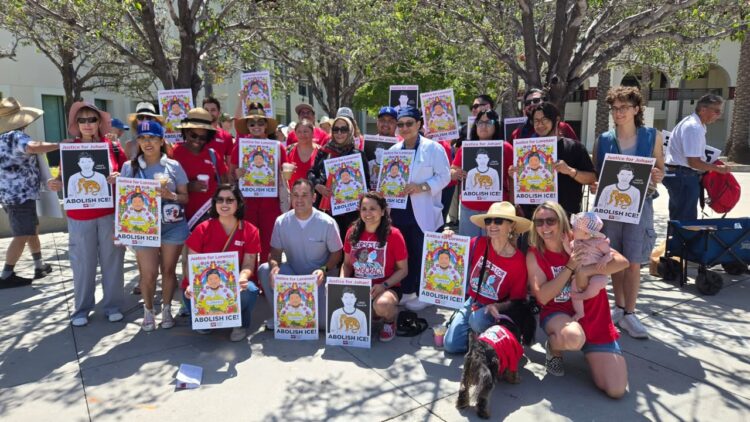
One of the protests featured about 40 nurses from the California Nurses Association, affiliated with the National Nurses Union, which recently approved a resolution against the blockade. They later held a press conference in Washington alongside congress members and Bob Schwartz, leader of Global Health Partners.
Members and leaders of the organization expressed interest in collaborating with the Hands Off Cuba Committee, especially in the initiative to raise funds and material aid for Global Health Partners’ campaign to provide prenatal vitamins to pregnant Cuban women.
“Our next shipment of more than 15 pallets of medical aid, which will then be transported from Jacksonville to Havana, leaves Los Angeles on August 4. It is being organized by Not Just Tourists, the Pan American Medical Association (graduates of ELAM), Global Health Partners, and the Los Angeles Committee for the Prohibition of Intervention in Cuba. Its estimated value is $750,000,”
