

A set of regulations formalizing the strengthening of social work—particularly the provision of small-scale productive assets to people experiencing multidimensional vulnerability, and the training and job-readiness program for young people aged 18 to 30 who are neither studying nor working—was published in the Official Gazette of the Republic.

This initiative seeks to help these people engage in economic activities and overcome conditions of vulnerability by generating their own income.
The program aims to create conditions that enable people and households experiencing vulnerability to engage in productive activity, generate their own income, and gradually strengthen their economic autonomy.
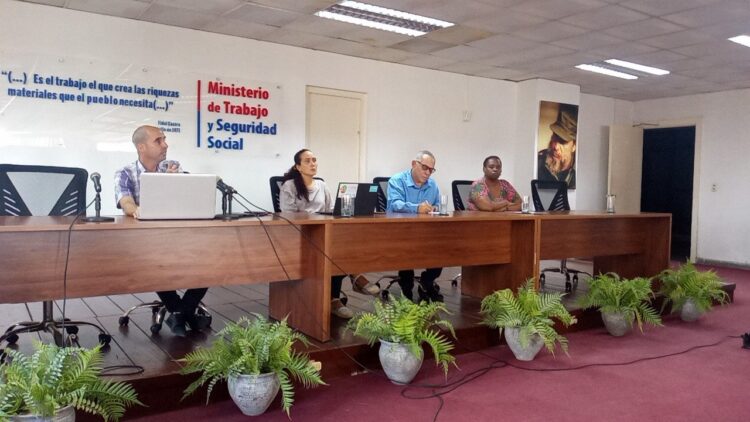
The press conference at which details of the approved regulations were announced—part of the measures being implemented by the Ministry of Labor and Social Security in response to the socioeconomic transformations underway in the country—was chaired by Jesús Otamendiz Campos, head of the ministry. He noted that the institution he leads has already been systematically working on developing the policies and regulations needed to implement the transformations, and that its task now is to follow up, ensure that the plans are carried out, and train the relevant structures, especially in local communities.
“This is not a process that can be won at the national level alone. We have to generate the greatest possible momentum among community stakeholders, because many of these transformations originate precisely in the community, in the electoral district, in the Popular Council, among those who are members of groups working on social policies, among social workers».
Mayli Morejón Concepción, director of the Social and Labor Observatory, explained that the program to provide small-scale productive assets to people in vulnerable situations aims to create the conditions for people and their households to engage in productive activity, generate their own income, and progressively strengthen their economic autonomy.
The initiative is based on the recognition that social assistance is necessary to address certain needs, but must be complemented by mechanisms that help prevent vulnerable situations from recurring and encourage income generation among those who are able to work.
The concept, then, is to empower people to contribute decisively to their own support and progress, according to their circumstances—something that will undoubtedly benefit them psychologically—while also establishing work as a fundamental value so that individuals and families can earn an income.
The program goes beyond the traditional approach of focusing on social assistance to meet households’ immediate needs. It promotes a form of social protection that combines work, prevention, and capacity building to generate sustainable income, enabling households and individuals to overcome vulnerability.
Therefore, the program aims to strengthen the economic autonomy and sustainable income of people and households in vulnerable situations.
Who is eligible for this program?
Eligibility is conditional on the household being in a situation of multidimensional vulnerability, having people who are able and willing to work, and being willing to comply with the economic inclusion plan developed for this purpose.
According to reports, the priorities will be aimed at caregivers, with activities compatible with their caregiving responsibilities. They will primarily include women with dependent children under the age of 18 and low incomes; young people aged 18 to 30 who are neither studying nor working; people with disabilities who are willing and able to engage in economic activity; and people working in the informal sector, for whom the program can offer a path to reintegration.
The program goes beyond the traditional approach focused on providing social assistance to meet households’ immediate needs. It provides social protection that brings together work, prevention, and capacity-building to generate sustainable income, enabling households and individuals to overcome multidimensional vulnerability.
What are the sources for acquiring these assets?
They include the state budget allocated to social assistance for vulnerable families and households; the social protection fund; the territorial contribution for local development; international cooperation; donations; bank microloans; and other sectoral and environmental funds, including funds established within the business system, or any other fund approved by the Council of Ministers.
What assets will be provided?
They will be small-scale productive assets, such as tools, utensils, light machinery, supplies, and low-cost equipment, both to purchase and maintain, compatible with the country’s technological and energy conditions and suitable for individual or family use.
The assets are provided through a loan-for-use agreement between the entity that assumes the cost and the beneficiary. The agreement is carried out under the planned terms and conditions and includes, among other things, the training program.
Israel Riverón Sánchez, director of employment official of the MTSS explained that applications to access the program are submitted to the municipal departments of Labor and Social Security, at the request of the individual, or even through social workers.
Training and preparation program for the labor market integration of young people aged 18 to 30
The program aims to reintegrate young people aged 18 to 30 who are not engaged in education or work into the education, production, and service-provision systems, facilitating their access to courses that improve their employability and job skills.
The program will prioritize employers’ needs and territorial development strategies. Priority will be given to residents of areas with high rates of youth disengagement, with particular attention to rural areas, and to low-income women with dependent minor children.
The training courses included in the program last up to six months, with a minimum of 20 instructional hours per week. Participants receive a monthly payment equivalent to the current minimum wage for the duration of the course. This monthly payment is funded through conditional social assistance benefits and is assumed by the support-assurance units of the administrative councils that oversee the labor departments when young participants are in vulnerable situations.
In all other cases, the young people’s monthly payment is covered by the budget of the entity offering the course, as provided for in current labor legislation.
Young people who are already enrolled in preparatory, advanced, or training courses, or who are continuing their studies, will not be eligible. Nor will those who unjustifiably drop out of the courses or fail to take up employment if they had previously benefited from the program and dropped out of the course or did not take up employment.
Rita Machín Reyes, Director of Social Work at the Ministry of Labor and Social Security, said when presenting the decree on strengthening social work that social workers are professionals who investigate the causes and circumstances of social problems and also help people participate, mobilize, and raise awareness in order to find solutions.
“The decree also establishes the principles that will govern social work in Cuba, including the principles of legality, solidarity, and participation, among others,” she said.


