

Solidarity with Cuba was once again present in Los Angeles, where the city’s Committee of the campaign “U.S., Hands Off Cuba!” (LAHOC) held an information and support day during the 56th commemoration of the Chicano Moratorium, celebrated on August 29.

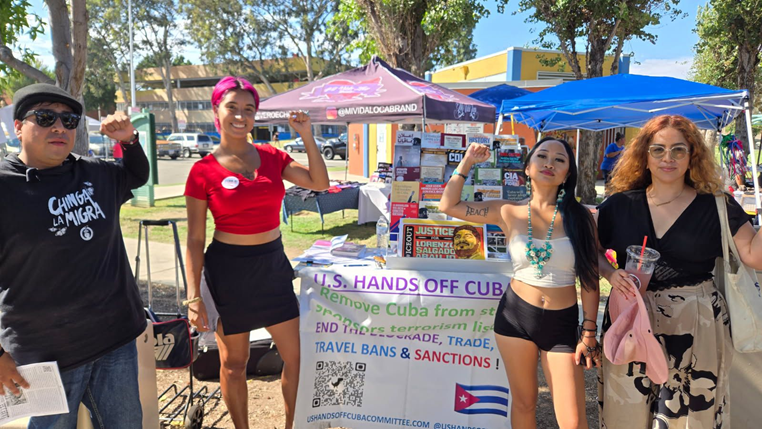
The gathering, held in East Los Angeles, brought together members of community organizations, activists, artists, and neighbors to remember the historic mobilization against the Vietnam War and to reaffirm struggles for social justice, self‑determination, and the rights of Chicano and Mexican‑American communities. This year’s edition took place at East Los Angeles College, with cultural activities, speeches, poetry, and information spaces.
According to a note sent to Trabajadores by Destiny Rivera, activist of the Hands Off Cuba Committee, LAHOC’s presence at the event allowed the distribution of information about the reality of the Island and the consequences of the economic, commercial, and financial blockade imposed by the United States. Cuban literature was made available to the public, and the medical aid campaign promoted by Global Health Partners (GHP) was highlighted, aimed at supporting the care of mothers and newborns in Cuba.
The GHP initiative seeks to raise funds to send essential equipment and supplies to Cuban maternity hospitals, including incubators, neonatal ventilators, monitors, obstetric ultrasound equipment, and medicines. The organization notes that its maternal and neonatal care project began as a pilot program in coordination with Cuba’s Ministry of Public Health and initially covers two Havana hospitals.
During the Los Angeles event, solidarity with Cuba resonated both among those familiar with the consequences of the blockade and participants who were unaware of its scope. According to LAHOC, several attendees approached their representatives to learn more about the restrictions affecting Cuba’s economy and health system.
Memory that becomes struggle
The Chicano Moratorium has its roots in the historic mobilization of August 29, 1970, when more than 20,000 people marched through East Los Angeles to protest the Vietnam War and denounce the disproportionate number of Mexican‑American youth sent to the conflict. The demonstration, initially peaceful, was repressed by police forces.
Among the victims that day was Los Angeles Times journalist Rubén Salazar, who was covering the protest and died as a result of the repression. His death turned the Moratorium into a symbol of the struggle for civil rights and against police violence in the Chicano community.
More than five decades later, that memory continues to connect with new social causes. The 2026 commemoration reaffirmed the unity of peoples and the need to keep struggles against injustice, discrimination, and intervention alive. In this context, the message of solidarity with Cuba found a natural space: the defense of sovereignty and self‑determination of peoples was linked to the demand for an end to U.S. coercive measures against the Island.
The work of the Hands Off Cuba Committee in Los Angeles is part of growing solidarity activity in California. In July, during a visit by Tanieris Diéguez, deputy chief of Cuba’s diplomatic mission in the United States, other initiatives to send medical aid to Cuba were announced, coordinated by U.S. organizations together with the Los Angeles committee, GHP, and other entities.
LAHOC’s next outreach action will take place on September 7, Labor Day in the United States, during a march and rally. Starting at 10:00 a.m., they will set up an information booth sponsored by the International Association of Machinists (IAM), with the aim of continuing to spread awareness about Cuba’s reality and expand solidarity networks with the Island.


