

This Wednesday, from the headquarters of the Ministry of Economy and Planning, representatives of the Ministries of Public Health (Minsap), Education (Mined), Domestic Trade (Mincin), Agriculture (Minag), and the Central Bank of Cuba, together with the National Institute for the Care of New Economic Actors (INAEN), presented at a press conference the main legal modifications introduced by Decree-Law 133/2026, which amends Decree-Laws 88 “On Micro, Small and Medium Enterprises (MSMEs)”; 89 “On Non-Agricultural Cooperatives (CPA)” and 90 “On Self-Employment.”
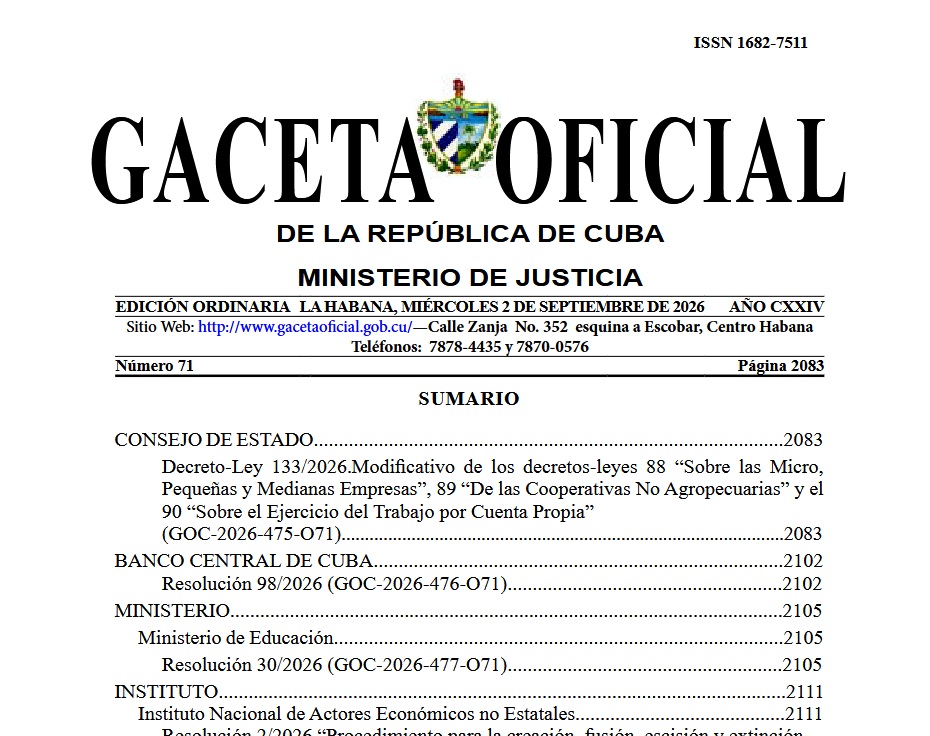

The legal framework represents a decisive step in updating the Cuban economic model. Its purpose is to streamline procedures and expand rights, integrating state and non-state actors into a single business system.
The regulation links to previous provisions such as Decree 160, which reduced prohibited activities for the non-state sector, and recognizes rights such as usufruct and surface rights for investments in land and industries. It seeks to remove barriers that hindered the growth of MSMEs, CPAs, and private companies, opening a more flexible framework for their development.
National Institute for the Care of New Economic Actors
INAEN President Lázara Mercedes López Acea stated that Decree-Law 133/2026 simplifies procedures and requirements, reduces approval times, and expands development opportunities for non-state management forms.
Among the novelties: private companies with more than 100 workers are recognized; individuals may be partners in multiple companies; and the corporate purpose of MSMEs and CPAs is broadened to diversify productive and service activities.

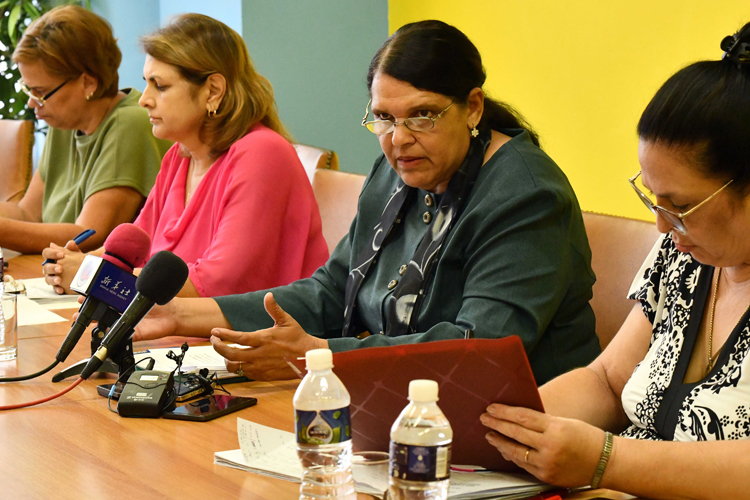
She emphasized that these measures aim to consolidate a unified business system where state and non-state actors jointly address local and national problems, strengthening the economy at the municipal level.
Decree‑Law 133 is linked to Decree 160, which significantly reduced the activities prohibited for non‑state actors, broadening the spectrum of investment and management opportunities. In addition, real rights of usufruct and surface are legally recognized, allowing private companies and cooperatives to invest in land and industrial spaces, responding to long‑standing demands from these actors.
“It is about opening opportunities for those who have already demonstrated management capacity to continue expanding, diversifying activities, and contributing to territorial development,” she emphasized. The president stressed that these measures aim to remove obstacles that had hindered the growth of companies that had reached a certain level but could not expand further.
Ministry of Agriculture
Deputy Minister of Agriculture Maury Hechavarría Bermúdez elaborated on the new Law on Agricultural and Forestry Lands, soon to be published in the Official Gazette. During the conference, he stated that for the first time MSMEs and private companies are authorized to receive land in usufruct, eliminating the limits on size and duration that had applied until now.
Hechavarría Bermúdez emphasized that this opening will allow large-scale projects in livestock, rice, and other crops, while also easing rules for importing seeds and genetic materials.
“Until now only agricultural producers, cooperatives, and state companies could access land. With this law, MSMEs and private companies will also have that possibility, which will allow us to scale up production and involve more people in farming,” he affirmed.
He insisted that land grants will now have no limit of size or time, depending on the project presented. He also explained that delays are eliminated—previously applications had to go through commissions and territorial delegations—now the land will be granted directly by the state company where it is located, with more agile procedures.
Finally, he recalled that there are 400,000 non-state producers and about 4,000 agricultural cooperatives, which demonstrates accumulated experience in working with private actors and provides a solid foundation for expanding these measures.
Ministry of Domestic Trade
The Ministry of Domestic Trade also presented innovative strategies aimed at diversifying supply and increasing transparency in non‑state activities. Deputy Minister Inalvis Smith Lubén explained that Decree 167 formalizes the figure of the street vendor, granting them a simplified tax regime and an identification card.
This officially recognizes a modality that until now was carried out informally, such as selling peanuts, coffee, or personal services, and gives it legal backing within self‑employment regulations.
Smith Lubén also outlined projects such as the Neighborhood Market, which for the first time addresses the administrative management of the local store, establishing a nomenclature of basic products and reducing sales taxes to impact prices. She also mentioned the Wholesale Market, which will allow bulk purchases with participation from both state and non‑state actors, expanding supply possibilities in municipalities.
The deputy minister emphasized that these transformations prioritize non‑state management and foreign investment in gastronomy and services, with the aim of diversifying supply and contributing to lower prices. She also highlighted the positive experience of non‑state actors in community food homes for vulnerable people and in services linked to students, demonstrating that coordination between the state and private sectors can generate effective solutions to social needs.
Ministry of Public Health
Director Cristina Lara Bastanzuri, from the National Directorate of Medicines and Medical Technologies of Minsap, reiterated that medical care will remain free and the exclusive responsibility of the National Health System.
The new development is the authorization for MSMEs to manage community pharmacies, sell medicines, and medical products, always under strict regulation. According to official data, 65 applications have already been received, with 36 projects approved, 14 endorsements granted, and three pharmacies currently in the process of being established.
Lara Bastanzuri emphasized that interested entities must meet infrastructure, professional staffing, and sanitary registration requirements, with support from state importers such as Medicuba S.A. and the Import‑Export Company Farmacuba. She also clarified that state community pharmacies cannot be leased: new private pharmacies must establish their own premises.
“A medicine has two sides: the benefit and the adverse reaction. That is why the responsibility of these new pharmacies will be high, and they will always be under the supervision of our regulatory authority,” she stated.
Another key aspect is that sanitary registrations will initially be temporary for two years, allowing demand to be assessed and later deciding whether they become permanent.
Ministry of Education
Likewise, First Deputy Minister of Education Cira Piñeiro Alonso presented a procedure aimed at regulating the participation of non‑state actors in complementary activities such as childcare, language classes, tutoring, shorthand, and typing.
The measure seeks to organize and supervise private offerings in these services, ensuring quality standards and user protection, especially for children and adolescents.
Piñeiro emphasized that the incorporation of private actors in the educational sphere must be accompanied by control mechanisms that guarantee consistency with public policies, avoiding distortions and ensuring that education maintains its inclusive and regulated character.
Central Bank of Cuba
Yannick Arensivia, Director of Economic Policies at the Central Bank of Cuba, announced a resolution authorizing non‑state actors to make cash deposits in foreign currency, credit them to bank accounts, and carry out withdrawals, always with a sworn declaration of legality.
This measure simplifies financial procedures and expands the operational possibilities of MSMEs and cooperatives within the national banking system, strengthening their management capacity and liquidity.
Arensivia emphasized that these provisions aim to provide greater financial support to new economic actors, fully integrating them into the Cuban banking system. The right to withdraw these funds is also recognized, which increases liquidity and allows private companies and cooperatives greater flexibility in their operations.
The provisions presented reflect a political will to make the legal and administrative framework more flexible, remove obstacles that hindered the development of economic actors, and promote their integration into territorial development strategies.
The coordination of all sectors — agriculture, trade, health, education, and banking — aims to strengthen national production, substitute imports, increase exports, and diversify services, in a context marked by the difficulties of the blockade and the need for local solutions.


