

Pinar del Río.— Since we arranged the interview, she specified details about the location of the building where she lives so she wouldn’t have to come down to meet us. There was no lack of courtesy in that act; she awaited us at the door of her apartment, on the fourth floor: “Is the staircase tough? Imagine how I get up here.”

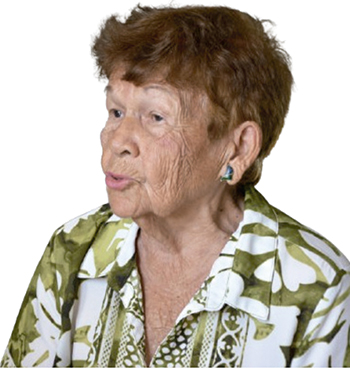
Edilia Fuertes Díaz will turn 89 on August 23, though no one would guess her age from the vitality of her movements and the clarity of her words. Just this past April, she was one of the women from Pinar del Río awarded the Honorary Title of Heroine of Labor of the Republic of Cuba.
Something unimaginable for the little peasant girl born in the family’s hut in the municipality of Candelaria, then part of Pinar del Río province. She was the youngest of four siblings. “We were very poor, my father had a small plot and my mother washed clothes for others; that’s how we survived. Even though she was illiterate until the Literacy Campaign, she always worried about her children studying,” she recalled.
Teachers insisted that Edilia continue her studies, so she went to live with an aunt in the city of Pinar del Río. “At the Superior School I completed seventh grade, and eighth grade at a private school in Candelaria; I took the entrance exam and enrolled in the Normal School of Havana.”
Without a permanent place to live, she stayed in several friends’ homes, including a classmate’s and relatives’. “By my last year, my sister had married, and her husband worked in one of the shops on Muralla Street in Old Havana. They lived nearby, so I moved in with them and finished my degree as a primary school teacher,” she said.
Thirst for Knowledge
“I immediately enrolled at the university. I was already substituting for teachers in Candelaria who were on maternity leave or sick, earning a little money. That allowed me to keep studying. I entered in 1955, but in 1956 the University of Havana was closed.
“When the Revolution triumphed, I joined a movement Fidel called from the Department of Technical Aid and Materials to the Cuban Peasantry. We were agricultural engineers, architects, doctors, nurses, teachers—we spread out across the mountains. I was in San Pablo de Yao; we were the first volunteer teachers.
“I stayed there a year, but then came the exams for permanent teaching posts. I was called to take charge of a school, and I began working as a rural teacher in a small school near the coast in Candelaria. In 1960 I re-enrolled at the university and completed my doctorate in Pedagogy. After that, I kept studying—I’ve always loved learning.”
She recalls that alongside her teaching career, she began as a union leader. “From that organization I held administrative posts. I served as municipal director of Education in Candelaria, then provincial deputy director for Primary Education, until I was replaced.
“I returned to Candelaria as a mountain teacher, and for a long time I was a leader in the Frank País brigade, until the Party brought me into the Municipal Bureau to oversee Education and other areas due to a shortage of cadres.”
More Studies and a New Beginning
In the 1970s she was offered a course in the Soviet Union. “In three years we became graduates in Social Sciences. I never stopped—I kept researching and studying. I earned a doctorate in Economics there, though I traveled back and forth; in the final year I stayed for 10 months.
“When I finished, I became a professor at the Provincial Party School of Pinar del Río Abel Santamaría Cuadrado, and I’ve been there since it opened. I retired, but I came back—I don’t want to stop working. Because once you stop doing what you love, the ailments come,” she emphasized.
Her love for the institution is simple: she never wanted to leave despite offers, especially from the Hermanos Saíz Montes de Oca University, where she worked on contract and exchanges but never left her center, because she is its founder, as well as of the Communist Party of Cuba. “For my pride, on September 1 I will complete 71 years of uninterrupted service,” she said.
She feels satisfaction in her work: “It’s your own result, when you later see them as doctors, leaders, even members of the Central Committee, ministers, vice ministers, and you say, that was my student. It makes you feel better and motivates you to keep learning.”
She regrets the reduced print runs of newspapers, which for her—without a cell phone—were a way to stay updated. She has never lost her bond with reading printed texts, marking what interests her and noting knowledge for her students.
A Challenge
“These transformations have me…” she pauses, then adds: “because they need explaining. Not everyone understands. As an economist, I’m searching for the reasoning, the theory… That keeps me studying. We need to work more on theory. It’s not enough to say we’re in socialism; we must prove we are building socialism.”

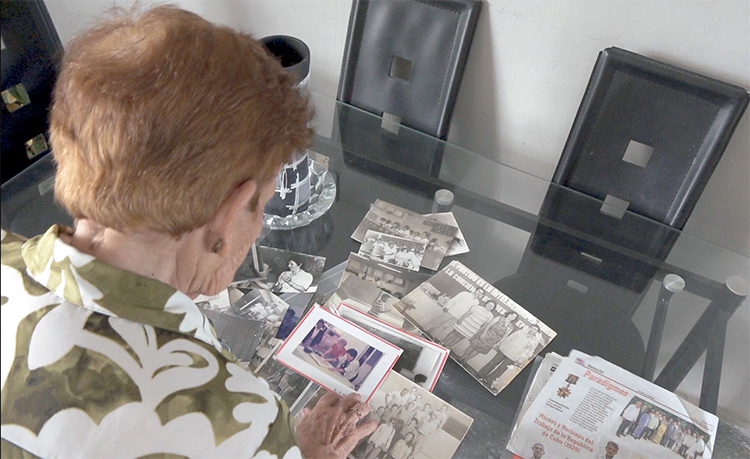
Her passion for teaching invites the question of vocation. “To be honest, it was the only thing I could study. Maybe I would have liked something else, but being a teacher, teaching young people, instilling love for the homeland and knowledge, taught me a lot. As a primary teacher I learned to treat children.
“I had a classroom from first to fourth grade. I was young, 18 or 19, and at first I used improper methods. One day, pressing a child to read, I saw tears in his eyes. I swore I would never treat a child like that again, and that taught me to love this career.”
The Other Edilia
With so much time in classrooms and academic merits, Edilia needs no introduction in those circles. But there is another side: the elderly woman who lives alone, though when she had chikungunya she spent two months at her only daughter’s home, a health worker. She admits her sister and mother helped raise her daughter: “Thanks to them I could do so much,” she says with moist eyes.
She is grandmother to four and great-grandmother to four more; the woman who at her age copes with blackouts “because the little panel they gave us Heroes doesn’t cover much”; the same who faces flooding from leaks in her apartment roof when it rains, who climbs to the fourth floor but proudly does everything at home, joking that she had no luck with husbands: “None lasted more than five years.”
She is the literacy teacher, the internationalist, the grateful recipient of all the honors she has received since her first medal in 1973 and now the Heroine of Labor. “I say it’s never too late if fortune is good. That’s the highest pride, to have such recognition and for the President of the Republic to place that medal on you—it was very great for me.”


