

The relevance of Fidel’s thought in the trade union movement was the theme addressed by Osnay Miguel Colina, Secretary General of the Workers’ Central Union of Cuba, in a panel held during the afternoon session of the inaugural day of the First International Colloquium dedicated to the Commander in Chief.

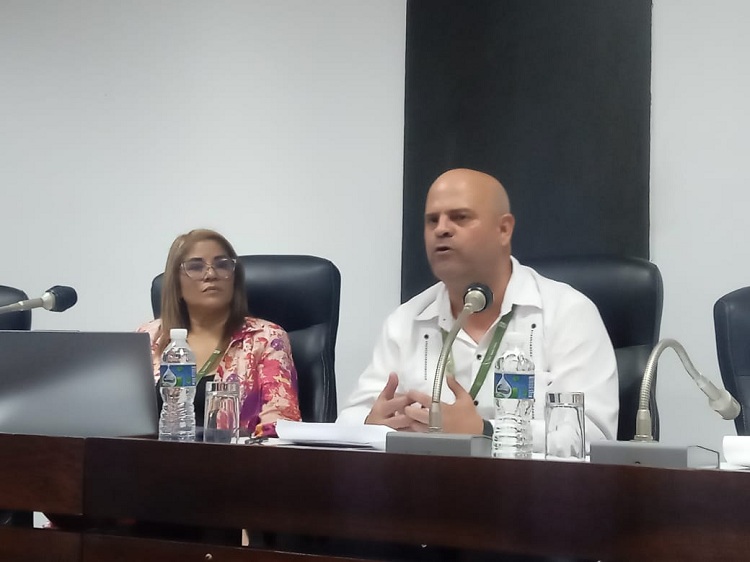
He emphasized that it is not about repeating speeches from another era, but about recovering principles and keeping them alive.
When asked whether those principles still have guiding capacity today, he responded that after the revolutionary triumph, the worker became not only a producer but also a political subject—surpassing his productive dimension to express social relations and participate in every process.

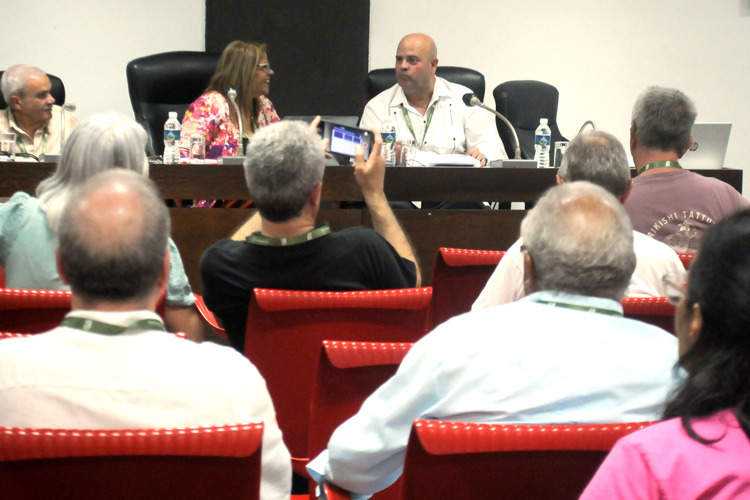
Furthermore, he added, as Fidel stated, the union cannot be limited to managing immediate demands; it must be a builder of consciousness and a defender of interests. It is a transformative entity that convenes workers and defends their rights.
Being able to convey workers’ opinions enriches decision-making, and both the administration and the State can improve their policies, he noted.
In today’s fragmented labor landscape, he said, unions must reach each worker to help build the collective project.
Regarding union democracy, he explained that it evolves from partial participation to full participation. This does not slow things down, he clarified, but rather contributes knowledge and collective capacity.
Thus, democracy ceases to be just a principle and becomes a condition for development, processing contradictions collectively rather than as irreconcilable antagonisms.
On worker ethics, he pointed out that labor is assumed not only as an external obligation but also as personal fulfillment and social responsibility. The worker is both a subject of rights and a participant in solutions.
As an example, he mentioned that despite the country’s difficult conditions, more than 70,000 interrupted workers have been relocated to productive and useful community tasks.
Commenting on the increase in non-state forms of management, he stressed the need for dialogue with them and better union attention so they can participate in solving difficulties.
He concluded that the worker is a social and political subject, the union has its own identity in relation to bureaucratic power, and socialism cannot be built solely with economic transformations but with subjects capable of commitment.
On the centenary of Fidel’s birth, all these ideas demonstrate their relevance and dynamism.
The Union: A Vital Space to Think and Make the Revolution
The first day of the colloquium opened with a question central to today’s union movement: Why return to Fidel Castro now? The answer is not simply to repeat speeches of the past, but to recover living principles that continue to guide workers’ organizations and adapt to contemporary challenges.
In the panel dedicated to Fidel Castro’s political method and its application in trade unionism, Professor Dr. C. Camilo Rodríguez Noriega of the Ñico López Party School presented a lecture titled “Theoretical Political Joys and Projection in Cuban Trade Unionism.” His intervention began with a clear premise: thinking about Fidel is essential for the political and cultural self-understanding of Cuban society.
Rodríguez Noriega organized his presentation into five essential theses outlining Fidel’s political method and its embodiment in unions as a fundamental arena:
- Transformative foundation — The method is rooted in the total transformative sense of the Revolution, articulating four inseparable marks: a new type of political power, a new ideological-cultural perspective, a new mode of production, and a new way of life.
- The people as subject — The Revolution is a work of the masses or it is not. The method ensures popular acquisition of revolutionary practices, ideological and cultural development, and sustains a new type of social power as popular political exercise.
- Systematic consultation — Listening to the masses and engaging publicly serve as antidotes to bureaucratism, creating a cultural-political vanguard from the people. Fidel conceived the Revolution as penetrating daily life, combating inequalities, and fusing class perspective with national well-being.
- Knowledge and sensitivity — The method synthesizes scientific knowledge, empirical wisdom, intuition, and political sensitivity. Politics is seen as the art of serving the people, where heart and intelligence march together.
- Subjective motor of the Revolution — As a child of culture and ideas, the Revolution requires will, discipline, organization, and public criticism. Self-criticism and rectification are battles of ideas, a collective learning cycle to adjust action to changing reality.
In synthesizing these theses, Rodríguez Noriega emphasized that Fidel’s method finds in unions a strategic functional space. Fidel radicalized Lenin’s metaphor of the “transmission belt”: not only to convey party lines, but for unions to be active subjects in leading the revolutionary project. Thus, unions integrate immediate demands with the radical transformation of labor relations, positioning the working class not as exploited but as fundamental in power.
From the Union Begins Transformation
Professor Jorge Bencomo Cuesta of the Ñico López Communist Party School elaborated on Fidel Castro and the role of unions in building the socialist project.
He began by thanking colleagues from Cuba and abroad, highlighting international solidarity as inseparable from the workers’ movement. His lecture traced the role of unions in constructing socialism since the revolutionary triumph of January 1, 1959.
Bencomo recalled that the arrival of the CTC and unions at that historic moment was no accident, but the result of a long trajectory of struggles and resistance. From their origins in the early 20th century, Cuban unionism was marked by Marxist influence and the generation of the 1920s and 1930s, with figures like Julio Antonio Mella, Rubén Martínez Villena, and Antonio Guiteras.
The general strike against Machado and participation in the constitutional process of 1940 were milestones demonstrating the workers’ movement’s capacity to influence national politics. The historical path also included clandestinity and persecution during dictatorships, with union leaders assassinated such as Jesús Menéndez and Aracelio Iglesias.
The CTC, born as the National Workers Confederation of Cuba (CNOC) and later transformed into the Central de Trabajadores de Cuba, endured internal divisions and government manipulation but kept resistance alive. This accumulated experience was decisive for the workers’ movement to actively join the revolutionary process in 1959 and support the struggle in the Sierra Maestra.
Bencomo stressed that in 1959 the initial goal was not to declare socialism but to achieve independence and anti-imperialism. In that transition, Fidel broke with the traditional idea that unionism should limit itself to economic struggle, leaving politics to parties. Instead, he argued that unions must become political actors and protagonists of revolutionary transformations. “The union cannot be conceived as an entity outside the process, but as a space where daily transformations are forged,” he emphasized.
In workplaces and union sessions, consciousness is built and workers’ active participation in constructing the new society is promoted. This Fidelist vision turns the union into a motor of unity and a pillar of popular power.
Finally, Bencomo highlighted that the unity of the Cuban trade union movement, and of other political movements, was consolidated under Fidel Castro’s leadership and example. “Unity was not a pre-existing fact,” he noted, “but a historical task achieved thanks to Fidel’s leadership and the union movement’s ability to integrate diversity into collective interests.”


