

Like the characters in Blindness by José Saramago, who lose not only their sight but also social order, the prolonged wait at Havana’s ATMs seems to gradually erase the boundaries of respect and coexistence. Obtaining money has become a true ordeal; disrespect, fights, and even thefts are the most common currency, reflecting a critical situation that persists day after day.
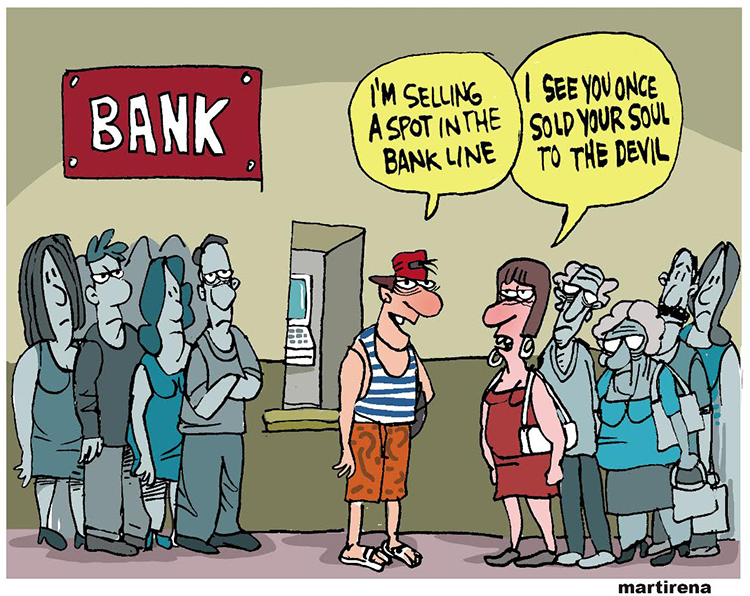

Access to and handling of cash is limited by several factors, such as the low return of money to the banking system, its concentration in small and medium-sized enterprises, price inflation that forces people to withdraw larger amounts, and frequent blackouts that interrupt the banking network and prevent withdrawals.
However, none of these inconveniences justify acts of vandalism like the one at branch 300, at Diez de Octubre and Lacret, where two ATMs were irreparably damaged—an incident that led Banco Metropolitano managers to safeguard the remaining machines inside the building.
In various areas near the bank, it is common to see the sale of spots in line to access ATMs, carried out by figures who thrive wherever services are scarce: the coleros.
It is also an open secret that money is exchanged through transfers with commissions of around 10%. In this context of scarcity, customers prefer these informal methods to avoid endless queues.
The limitation on withdrawals has sparked disputes between financial service staff and customers. Shouts, insults, and even legitimate questions such as “What can I do with less than 3,000 pesos?” or “Who will accept payment with 5-peso bills?” are part of the tensions released by those who remain standing, often under the sun after long waits.
No argument can justify physical or verbal aggression from either side. Yet, a lack of empathy is often evident among those involved, who prefer to argue, insult, and push each other rather than remain calm or ask officials for a viable solution.
The most worrying aspect is not only the absence of the coveted paper currency or the conflicts, but the normalization of these behaviors. When abuse and disrespect begin to be accepted as routine, the problem ceases to be merely economic and takes on an ethical and social dimension. Addressing this crisis depends not only on demanding good behavior, but also on reviewing banking mechanisms to prevent scarcity from continuing as a daily scene of confrontation.


