



 Cargando...
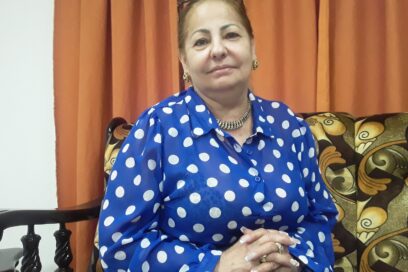
Gise’s first love, as her family calls her, was not love at first sight.
“Day by day I fell in love with what I studied as I moved through all the positions related to Accounting, serving as an economist and later as director of the Drilling Company in Venezuela,” recounts Gisela Rodríguez Santana, originally from that municipality in the south of Ciego de Ávila province.
“I had a deep love relationship with that entity for 15 years,” she emphasizes, and the reciprocity was so fruitful that the staff of the center earned the status of National Vanguard for nearly a decade.

“I felt very sad to leave, but I was given the task of assuming the direction of the Hydraulic Utilization Company (EAHCA, in Spanish). So I came to the provincial capital, where the first challenge was meeting with 18 hydraulic engineers, who at that moment put me in a tight spot because my training is in economics. But their support was, and continues to be, unconditional.”
— I suppose this other relationship has also been unlimited with a team that, under your leadership, has maintained National Vanguard status for 18 consecutive years.
“I believe so. Water resources represent a source of life and our main mission is to contribute to their optimal use. However, I consider the greatest strength here lies in the personnel, which is why we strive to care for them so they don’t feel the need to migrate to another organization.”
— What kind of care?
“Certainly, salaries are not high because we are service providers. Still, we look for solutions, and food is a priority. Last year workers received 220 pounds of milled rice, and so far this year we’ve delivered 80 pounds, coming from self-sufficiency areas where root vegetables and greens are also grown, mainly around hydraulic works in the municipalities of Chambas and Florencia.”
— A relief in the face of the difficult economic situation.
“Indeed, today’s mission is complex: meeting the monthly income plan of six million pesos. Nevertheless, we apply alternatives and move forward, even though activity levels have dropped in various sectors. For example, agriculture is depressed due to energy resource restrictions, and its units represent 90 percent of our clients in the water balance. That commits us to apply variants to sustain sales and raise income levels, which in 2025 surpassed 69 million pesos (106.1% of the plan) and in the first half of this year reached 32 million (105.3%).”
— Drought, another setback.
“Of course. Even though the water balance covers the needs of users and the economy, the Ruspoli supply sources are depleted. They should have supplied the provincial capital and other areas from the north, so now we must pump from the south where water is available. It’s a complex operation and lengthens the water distribution cycle.”
— Stress grows with that. How do you ease it?
“When I get home, my granddaughter Valeria takes care of pulling me out of difficult moments with her affection and a board game. I also receive great support from my husband, son, and daughter-in-law. They are my anti-stress, along with my hobby of making homemade sweets—by the way, my guava pie turns out delicious.”
She also excels at organizing activities to honor those she considers her loves in her second home. Almost ready is the celebration at EAHCA of the provincial event for Hydraulic Workers’ Day, which will not be held, as usual, on August 10, but on the 13th, as a cultural gift to Commander in Chief Fidel Castro Ruz on the centenary of his birth.
Acerca del autor

Licenciado en Comunicación Social. Economista y periodista. Escribe sobre asuntos económicos, agropecuarios, de la construcción y la cultura. Multipremiado en concursos de periodismo, festivales de la radio y otros eventos. Atesora las distinciones Félix Elmuza y Raúl Gomez García, los sellos Laureado y 50 aniversario del periódico Trabajadores, y la Moneda Conmemorativa 60 aniversario de la UPEC.
