


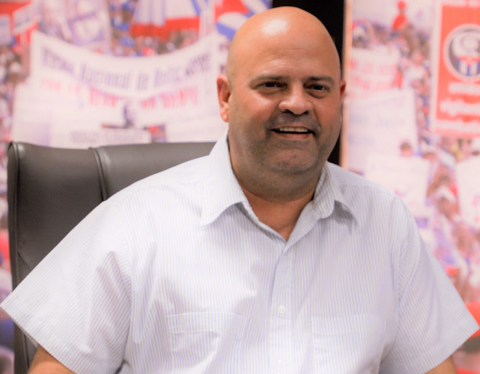


He explained that “the Congress began long ago, and the essential work has already been carried out in union sections, union bureaus, municipal and provincial conferences, as well as in some national conferences of the 15 unions that make up the CTC.” The process started in January 2024, and these concluding sessions will be conducted in an austere and rational manner, closely aligned with the country’s current reality.
Delegates and guests will gather in each province, while in Havana only the capital’s delegation and those proposed to join the CTC National Council will be present. “The Congress must resemble its time and adjust to the economic and social situation experienced by all Cubans,” Colina emphasized.
Main Concerns and Ideas for Debate
Colina explained that the Organizing Commission of the 22nd Congress was created a year ago to strengthen the organization’s structure, carry out the process at the grassroots level with depth and quality, and examine all the workers’ ideas and concerns that require answers.
The central debate will focus, first and foremost, on the defense of the Homeland and socialism, from any trench—whether in the fields, in classrooms, or, if necessary, with weapons in hand.
He also noted that exchanges will include proposals and positive experiences that help boost food production, energy transformation, and the enterprise system, involving all economic actors, as analyzed in the XI Plenum of the PCC Central Committee.
“This will lead us to discuss deeper issues. For example, how wages are formed, how work is organized, how profits are distributed, what role the collective plays in decision-making, and how workers are represented in management councils.
“We must ensure that the Assembly of Affiliates increasingly becomes an expanded management council, where everything necessary, useful, and important is addressed. We will also debate how accountability to workers should not be formal, but rather include counterarguments, experiences, and even contradictions, to drive development,” he said.
The union leader reviewed topics likely to spark multiple interventions from delegates: how to better harness knowledge, and why many companies fail to allocate sufficient funds to advance science, robotics, and artificial intelligence.
Naturally, the community outreach of the CTC will be another agenda item, covering three dimensions: the workplace’s relationship with its surroundings; unemployed workers who can form brigades or even temporary union sections in neighborhoods; and efforts to support disconnected individuals by finding them opportunities within communities.
Finally, Colina reviewed processes in which the organization has participated during the period culminating in this Congress, such as the analysis of the draft Labor Code—consulted with more than two million workers across all management forms—and the proposals and concerns presented by the CTC to the Government’s Economic and Social Program, which set concrete tasks through 2026.
“We must close a cycle and celebrate the Congress despite all the adversities we know—it is a challenge. We must aspire to generate substantial change in workplaces, neighborhoods, and society, so that the working class plays a more decisive role at this crucial moment for the Homeland,” he concluded.


