




 Cargando...
The Captain of the Cuban Working Class, Lázaro Peña, asserted: “The assembly is the union, and its quality conditions the work of the union. It is the vehicle for exercising the individual right of each worker and of the collective, in adopting agreements, strategies, ways, and measures for the benefit of the labor collective.”
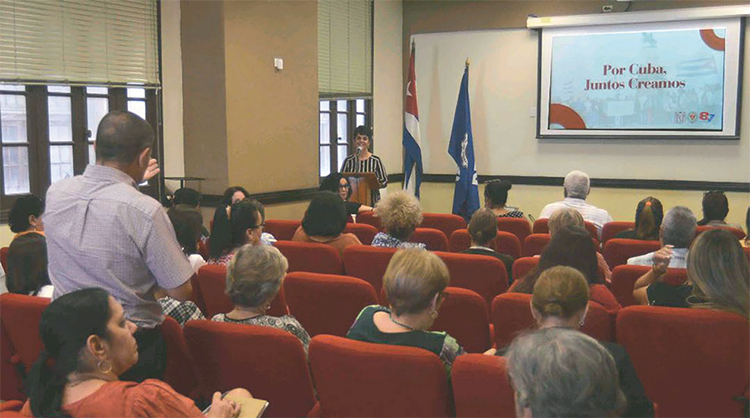
On its preparation he pointed out: “Without a general assembly there is no democracy, and without democracy the leadership isolates itself from the masses. Without a general assembly workers have no place to debate their ideas, petitions, or grievances.”
In the theses of the XIII Congress of the Cuban Workers’ Federation (CTC), 1973, the forms were established in which the union movement must intervene in administrative and state management—for example, in identifying reserves to solve problems that prevent raising results, as well as in proposing useful initiatives and experiences.
Commander in Chief Fidel Castro Ruz, at the closing of that conclave, declared: “This makes reality an old revolutionary aspiration of giving organized workers the maximum participation in economic management, as corresponds to them in a socialist process.” Nevertheless, the practical implementation of those provisions continues to be a challenge.
The Current Situation
The Constitution of the Republic of Cuba, in its Article 20, states: “Workers participate in the processes of planning, regulation, management, and control of the economy.” Similar rights are ratified in the Labor Code, to cite the principal laws of the country’s society and labor system.
This implies that the assembly takes on maximum importance both for the union organization and for achieving harmonious work between the administration and the collective.
Likewise, as part of institutionalization, legal norms of different ranks have been systematically enacted, many of which significantly impact collectives and their members. The long-awaited autonomy is a reality with which we must coexist, and for which we must prepare, with the duty and commitment to advance.
It is increasingly frequent that essential decisions and the authority for their application are materialized at the grassroots level; and for this, greater participation has been granted to the union organization and the assembly of members.
Each national union has the responsibility to draft and update its regulations for holding assemblies of members and workers, and also to contribute to the preparation of an agenda that motivates attendance, with the objective of turning the meeting into an attractive setting in which key issues of the entity and the collective are analyzed—such as payment systems, distribution of profits, incentives, and commitments to increase production and services.
The implementation of Resolution 146 of the Office of the Comptroller General of the Republic, regarding the Methodology for Administrative Accountability to Workers, must constitute a point of analysis in that setting.
*Member of the Organizing Commission of the 22nd Congress of the CTC.
