

On Saturday, the Havana Convention Palace also hosted the International Symposium The Right of Peoples to Decide Their Destiny in the Contemporary International Scenario, conceived as a space for analysis and collective commitment. Trade union delegates, academics, and representatives of solidarity organizations gathered to debate the impact of the blockade, alternatives for cooperation, and the right of peoples to decide their destiny.

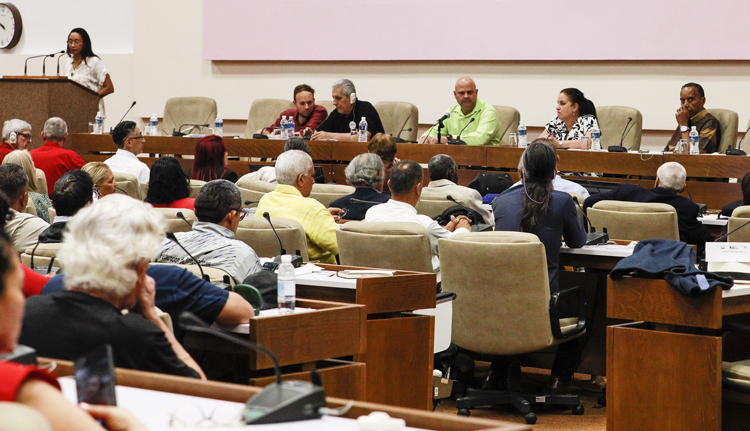
The meeting was chaired by Maridé Fernández, member of the Central Committee of the Party and head of its Department of Social Sector Affairs; and by Osnay Miguel Colina Rodríguez, president of the Organizing Commission of the 22nd Congress of the Workers’ Central Union of Cuba, along with other Cuban and international union leaders.
This space, following the Solidarity with Cuba Meeting, reaffirmed that the island’s voice multiplies in plural dialogue and that solidarity is not limited to symbolic gestures, but becomes critical thought and shared action.
During the International Symposium, the voice of the World Federation of Trade Unions (WFTU) was represented by George Mavrikos, historic Greek leader and former Secretary General of the WFTU, who delivered a lecture titled Cuba Is Not Alone. His intervention reaffirmed the condemnation of the economic blockade imposed by the United States against Cuba and highlighted the relevance of international workers’ solidarity as a tool of resistance and unity. Mavrikos’ presence brought historical continuity to the WFTU’s commitment to the Cuban Revolution, linking global trade union struggles with the defense of the island’s sovereignty.

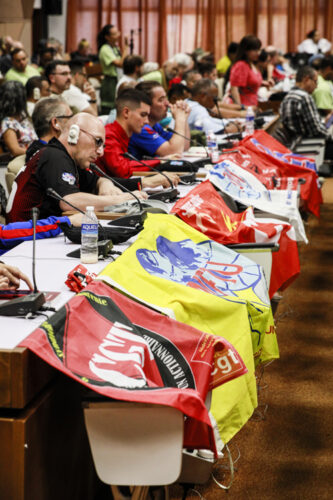
He emphasized the presence of delegates gathered in Havana as living proof that Cuba is not alone and that its efforts enjoy international support. With irony, he recalled that for Trump, “all of us are dictators,” but stressed that workers maintain their pride and their struggle intact.
The leader called on each delegate, upon returning to their countries, to promote signature campaigns in support of Cuba, regardless of political colors or differences, following the example of the Cuban people. “Each signature is a weapon to confront the blockade and imperialist aggressions,” he affirmed, urging solidarity to be transformed into concrete and multiplied action in every corner of the world.
For her part, Dr. Olga Rodríguez Ríos spoke about the reasons to fight for a better world. Rodríguez Ríos emphasized that our alternative is the construction of socialism, the path the Cuban people have and will continue to follow with extraordinary commitment. To those present, she said: “You are part of our hope and our struggle.”
In Defense of Sovereignty
During the Symposium, two panels were presented. One was dedicated to digital hegemony, geopolitics, and sovereignty, opening a space for reflection on how major powers attempt to impose narratives and structures of control in virtual environments. It was stressed that the struggle for technological sovereignty is not only a matter of innovation, but a cultural and political battlefield where peoples’ ability to decide their own destiny is defined. In this context, Cuba stands firm against the contemporary imperial offensive, defending its right to build its own communicative and digital models, capable of resisting power concentration and affirming a national identity that does not submit to global domination logics.
The Symposium was not only an academic exchange, but a collective act of affirmation in the face of today’s challenges. The voices raised around digital hegemony, geopolitics, and sovereignty, along with other panels, made clear that the battle for cultural and technological independence is inseparable from the defense of national dignity. In this horizon, Cuba remains firm against the contemporary imperial offensive, calling for unity, creativity, and critical consciousness as essential tools to open paths of justice and emancipation.
In the closing conference, Osnay Miguel Colina spoke on Digital Hegemony and Peoples’ Resistance: Communication, Power, and Informational Sovereignty in the Contemporary International Scenario.

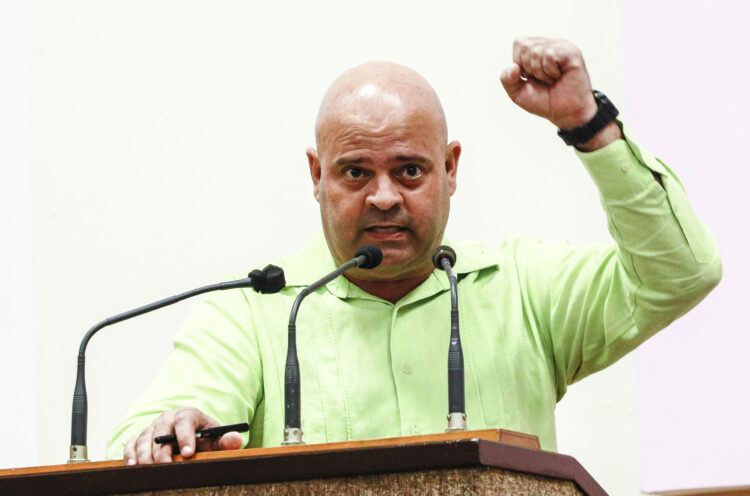
The presentation emphasized that the digital space has become a strategic terrain of hegemonic dispute, where technological corporations and dominant powers shape perceptions and legitimize narratives on a global scale. From Latin American and Caribbean emancipatory thought, it was denounced that this concentration of informational power reproduces capitalist inequalities and creates new forms of political and cultural domination.
It was argued that political communication today is a structural dimension of power, and that the battle for consciousness is fought in the digital ecosystem. In response, informational sovereignty is proposed as a strategic category, especially for the trade union movement, called to build counter-hegemonic narratives, foster critical awareness, and articulate international solidarity networks.
The intervention highlighted that mere presence on social networks is not enough: a conscious communicative praxis is required, capable of producing its own meaning and strengthening organization. Trade unionism, with its internationalist tradition and direct link to workers, has the potential to lead this task, provided it assumes communication as a political priority.
Finally, it was recognized that digital hegemony is not absolute: there are experiences of alternative media, media literacy, and technological sovereignty that demonstrate the possibility of peoples regaining the ability to narrate themselves.


