

The presence of the U.S. delegation at the Trade Union Internship organized each year by the Workers’ Central Union of Cuba ([su_tooltip title=»Central de Trabajadores de Cuba (CTC)» text=»The CTC (Workers’ Central Union of Cuba) was founded on January 28, 1939 by Lázaro Peña under the name Confederación de Trabajadores de Cuba (Confederation of Cuban Workers)» background=»#fa9800″]CTC[/su_tooltip]) takes on special meaning in the context of May Day celebrations. Coordinated by activist Mark Friedman, founder of the Hands Off Cuba Committee, about fifty visitors have arrived with a clear purpose: to understand Cuban reality, exchange with its people, and bring back a vision that is certainly different from the one that predominates in their country.

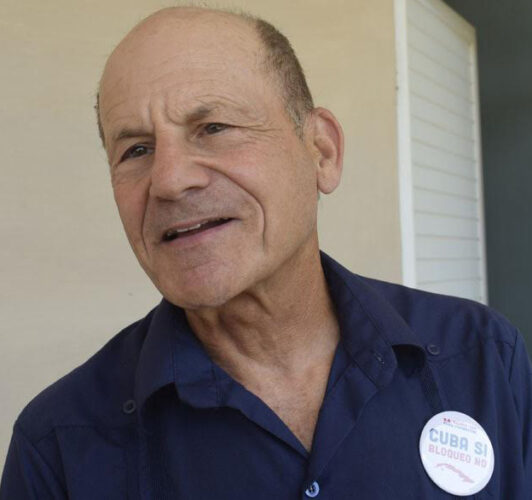
In a nation preparing for one of the largest mobilizations of the year—the International Workers’ Day parade—the members of the delegation not only participate in academic and exchange spaces, but also join a program that combines training, solidarity, and direct contact with Cubans.
After the Internship concludes on April 28, the group will carry out an intense program in Havana that includes participation in the May Day parade at the Plaza de la Revolución, as well as the Solidarity Meeting at the Convention Palace. They will also visit the University of Havana, the Calixto García Teaching Clinical-Surgical Hospital—where they will deliver donations of medicines and supplies—and hold meetings with leaders of the [su_tooltip title=»Central de Trabajadores de Cuba (CTC)» text=»The CTC (Workers’ Central Union of Cuba) was founded on January 28, 1939 by Lázaro Peña under the name Confederación de Trabajadores de Cuba (Confederation of Cuban Workers)» background=»#fa9800″]CTC[/su_tooltip] and the Cuban Institute of Friendship with the Peoples (ICAP). In addition, they will tour the National Aquarium, with which they maintain environmental research projects, and engage in exchanges at the editorial offices of Granma and Trabajadores.
Union Struggle from Within
Among the visitors, young people predominate, and a group of Teamsters union leaders linked to the e-commerce giant Amazon stands out. Most of them work in the logistics sector, and their testimonies reveal the complex labor landscape in the United States.

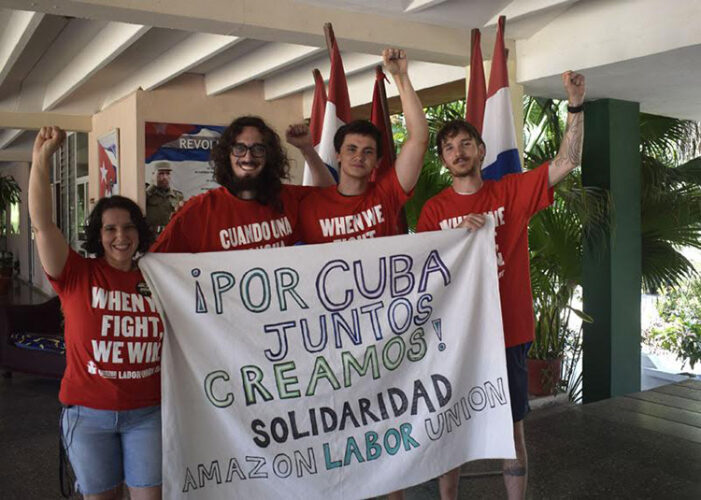
Amber Longo, a worker in California, sums up the spirit that brings her to the Island: to understand the strength of a social process that has resisted for decades. “I want to understand how Cubans organize, where that resistance comes from, so I can explain it to my coworkers,” she says.
From Atlanta, Hunter Richau, member of Teamsters Local 728, goes beyond the gesture of solidarity: “We are not only here to support; we want to learn so we can make our own revolution in the United States.”
Along the same lines, Avi Tacha Fram, a unionist in New York, insists on the need to dismantle narratives: to learn how Cuba has resisted more than six decades of blockade and to spread that reality in his country. “Millions of Americans could benefit from a system like Cuba’s,” he maintains, while stressing the importance of pressuring his government to change its policy toward the Island.
Perhaps one of the sharpest views is that of Luke Badger, who describes working conditions inside Amazon as part of a global problem. He denounces the lack of contracts for more than one and a half million workers in the United States, the outsourcing of jobs, and the company’s evasion of responsibilities. “The struggle inside Amazon is the struggle of the world’s working class,” he affirms, pointing out how that exploitative model has spread to other large corporations.
Youth That Questions and Seeks Answers
Several young university students and recent graduates from New York have also joined the group, their interest in Cuba intertwined with other international causes.

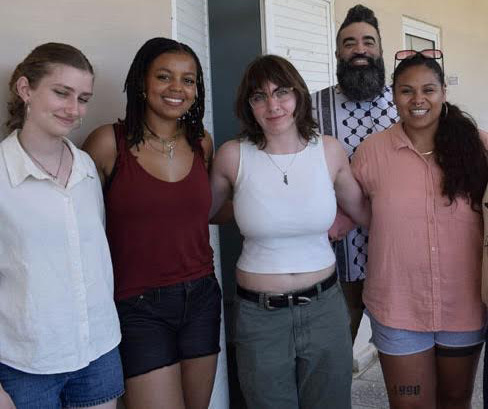
Maya Napthali highlights the need to learn firsthand about the effects of the blockade and share that information in her country. She also links the Cuban cause with other global struggles: “The imperialism that oppresses Palestine is the same that blockades Cuba, that’s why we say the struggle is one.”
Trinity Pereira, meanwhile, acknowledges that her visit responds to the need to contrast the information circulating in the United States. An activist in leftist organizations, she says she does not fear the anti-socialist campaigns which, in her case, have served to reaffirm her political commitment.
For Kristen Leopold, a recent graduate in International Relations, the trip also has an emotional component: “I have come to recharge with hope.” She denounces the unjust demonization of socialist ideas and shared some of her experiences defending immigrants against Immigration and Customs Enforcement (ICE) raids, which have become practices that undermine the rule of law.
From Military Experience to Peace Activism
After 12 years of service in the U.S. Army, Heather Carlos is now active in pacifist organizations such as About Face and Veterans for Peace. She represents that growing part of the American people who are against war because they lived it from within.
Her experience in conflicts such as Afghanistan led her to question her country’s role in the world. “I wanted to understand why we were sent to impose certain policies by force,” she explains. She now dedicates herself to educating about the human and economic costs of wars and warns about the repetition of imperial violence patterns in current scenarios.
“Last year we went to Washington DC to protest against imperialism, against the use of the military for repressive purposes inside the United States, and also against the blockade of Cuba,” she recounts. “On that occasion about 60 veterans were arrested. Recently the action was repeated and this time 130 were detained. We know that coming to Cuba may cause legal problems, but we are ready; we know what we have to do and say.”
A Bridge Under Construction
Amid May Day activities, these voices find in Cuba a space for learning, reflection, and articulation. Beyond political differences and national contexts, their testimonies converge on one essential point: the need to build bridges between peoples.
The Trade Union Internship, conceived as a space for academic and practical exchange, reaffirms itself as a platform for international dialogue among workers, students, and activists.


