



 Cargando...
 Can anyone explain why certain product prices in USD stores range from 0.75 to 0.96, or from 1.85 to 1.90, when neither the stores nor the customers have fractional currency? Is it so difficult to realize that once these prices are made official, they become the perfect fuel to increase buyers’ indignation? Are the serious problems this can cause taken into account?
The truth is that ever since the days of the CUC, such absurdities have repeated themselves. Back then, the store offered compensation: if they couldn’t give you fractional change, they gave you candies, some sweets, matches, etc., depending on what they had in stock. But now, with USD stores, the solution is Solomon-like: no change, take it or leave it! At least that’s what happened to me.
Surely, this phenomenon can provoke scenes with tragicomic overtones and endings hard to explain—especially when the customer, with every right, refuses to leave without those 10, 15, or 20 cents that cost him so much to earn, and tells the shop assistant she must dig them up from under the earth.
I was the protagonist of such an event, made worse by the fact that once I bought the product, the clerk, without a second thought, turned her body to chat with a coworker—perhaps believing the customer was obliged to leave her the 20 cents as a tip.
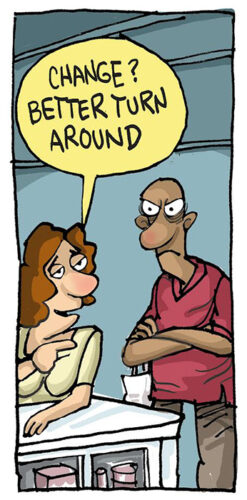
“Where’s my change?” I said, and she coolly replied that she had none, looking at me in astonishment, as if demanding my 20 cents were some extraterrestrial act, the behavior of a despicable man who fights for his money and therefore seemed mean and petty.
“This is the situation we have. If you don’t agree, then don’t buy the product,” she said. Humiliated, I had to leave without the product—which I badly needed—and with tremendous frustration. “I take it or leave it, I have no other choice,” I concluded, trying not to think about the final fate of those 10, 15, or 20 cents.
How many similar scenes could have been avoided if, when setting prices, logic had prevailed instead of absurdity? Horrors will be seen!
